

A survey by Laundry and Cleaning News found that 56% of people find clothing care symbols confusing, whilst a further 24% admit they don't understand these cryptic icons at all. It is a common frustration to stand before a washing machine, holding a cherished wool coat or a delicate silk dress, and feel a sense of dread as you try to decipher the tiny markings on the neck label. You've likely wondered whether a "Dry Clean" instruction is a firm rule or merely a cautious suggestion, fearing the moment a favourite item emerges from a cycle significantly damaged or shrunk. Understanding dry cleaning symbols is not merely about following instructions; it's about respecting the craftsmanship and heritage of the textiles you wear every day.
This guide provides the professional reassurance you need to master the intricate language of care labels so you can preserve your most valued garments for many years to come. We shall examine the technical differences between P and F solvents, explore the risks of ignoring manufacturer advice, and clarify exactly when a piece requires the meticulous attention of a specialist. By the end of this consultation, you'll possess the quiet confidence to identify every symbol and know precisely when to entrust your wardrobe to a master craftsman.
Key Takeaways
- Learn to confidently identify universal dry cleaning symbols to ensure your garments receive the precise treatment their delicate fibres require.
- Understand the technical difference between P, F, and W icons, which dictate the specific chemical solvents a master cleaner must utilise to protect fabric integrity.
- Master the meaning of subtle modifiers, such as bars and dots, which indicate necessary adjustments to mechanical action and temperature during the cleaning process.
- Discover why "Dry Clean Only" is a vital instruction for maintaining the internal structure and tailored fit of high-quality suits, coats, and evening wear.
- Gain peace of mind by learning how a professional heritage approach protects your wardrobe through meticulous label inspection and expert craftsmanship.
Understanding the Language of Dry Cleaning Symbols
The humble care label often feels like a minor detail, yet it serves as a garment's essential blueprint for longevity. At the heart of this system is the circle, which serves as the universal indicator for professional textile care. Manufacturers across the globe rely on these international laundry care symbols because they provide a standardised, language-free method of communication. This ensures that whether a silk blouse is tailored in Milan or a wool coat is crafted in London, the instructions for its preservation remain perfectly clear to specialists. By mastering the language of dry cleaning symbols, you effectively become a guardian of your own wardrobe's history.
Distinguishing between the washtub icon and the circle is the first step in avoiding catastrophic wardrobe errors. Whilst the washtub signifies home laundering, the circle explicitly directs the item toward professional expertise. Ignoring these dry cleaning symbols often leads to irreversible fabric decay, such as the breakdown of delicate fibres or the dreaded bleeding of rich dyes into lighter panels. Once these structural changes occur, the damage is frequently permanent, making the initial consultation of the label a vital habit for any garment owner.
The Five Families of Fabric Care
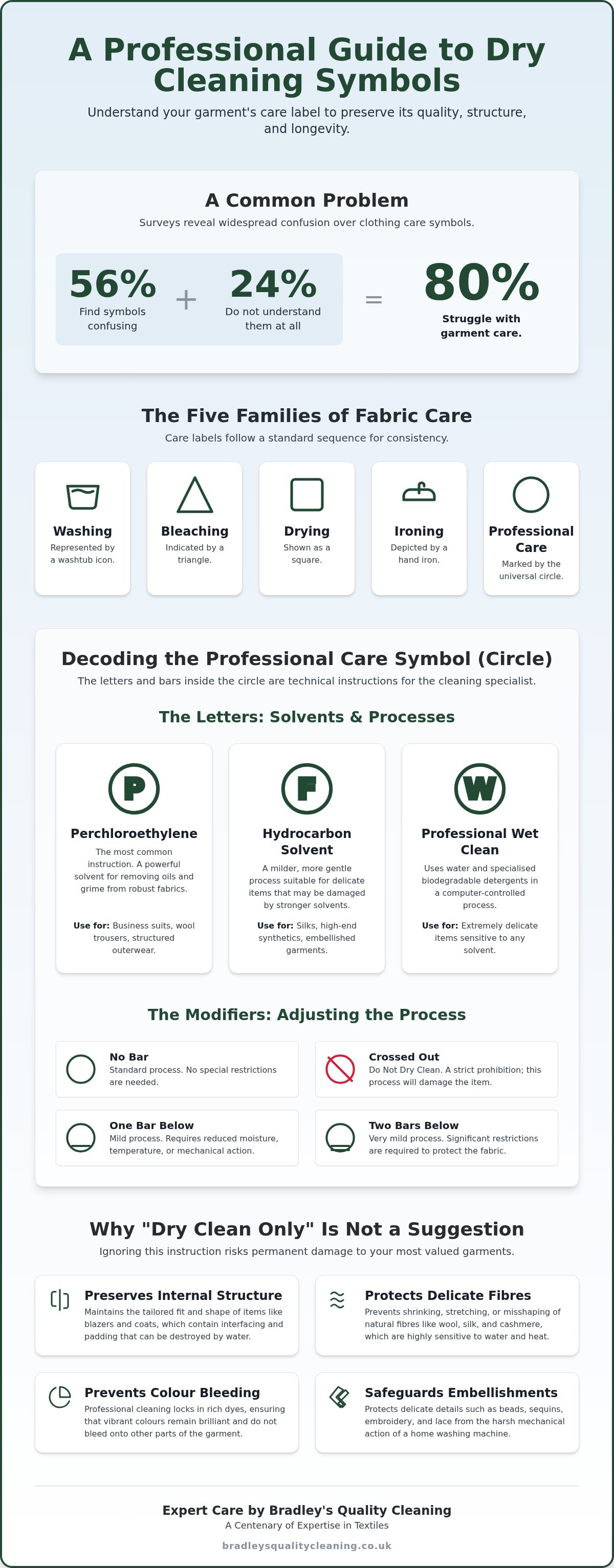
Every care label follows a specific, logical sequence established by the BS EN ISO 3758 standard to ensure consistency across the UK and Europe. This sequence typically presents five distinct families of care:
- Washing: Represented by a washtub icon.
- Bleaching: Indicated by a triangle.
- Drying: Shown as a square.
- Ironing: Depicted by a traditional hand iron.
- Professional Care: Marked by the universal circle.
Since 1912, Bradley’s has deciphered these sequences for our clients in Milton Keynes. We understand that this order is not accidental; it reflects the chronological journey of a garment through a cleaning cycle, ensuring that each stage of the process respects the material's unique requirements.
The Basic Circle: Your Invitation to Professional Expertise
A plain, empty circle serves as the foundational instruction for "Professional Dry Clean Only" without further restrictions. When a designer places a plain circle on a garment, it suggests that standard professional processes are entirely safe for the fabric and its construction. Following this intent provides the emotional peace of mind that your investment is being handled with the exact level of care the creator envisioned. It removes the guesswork from garment maintenance, ensuring that the internal structure of items like tailored blazers remains crisp and undisturbed for years to come.
Decoding the Letters: P, F, and W Symbols Explained
Whilst the circle itself signals the need for professional care, the letters contained within it act as a technical dialogue between the garment's manufacturer and the cleaning specialist. These characters are not instructions for the consumer; rather, they specify the exact chemical solvents and mechanical processes required to cleanse the fabric without compromising its structural integrity. Modern professional technology has evolved significantly, allowing heritage cleaners to utilise more eco-friendly alternatives whilst maintaining the high standards expected for luxury items. For a clearer visual reference on how these icons appear, you may consult this American Cleaning Institute guide to fabric care.
Understanding that different fabrics react uniquely to specific chemical solvents is the hallmark of a master craftsman. Applying the wrong solvent can lead to the dissolution of internal adhesives, the loss of fabric lustre, or even the melting of synthetic fibres. This technical precision is why these dry cleaning symbols are so vital; they remove the element of chance from the preservation of your wardrobe.
The "P" Symbol: Perchloroethylene and Standard Solvents
The "P" symbol remains the most prevalent icon found on British high-street garments. It indicates that the item is resistant to perchloroethylene, a powerful solvent capable of removing oils and deep-seated grime from robust fabrics. This is the standard directive for everyday business suits, woollen trousers, and structured outerwear. It tells the cleaner that the fabric possesses the durability to withstand standard dry cleaning cycles without the risk of damaging the textile's weave or structural interfacing.
The "F" Symbol: Delicate Hydrocarbon Cleaning
When you encounter the "F" symbol, it signifies that the garment requires a more gentle approach using hydrocarbon or petroleum-based solvents. These solvents are less aggressive than perchloroethylene, making them essential for delicate silks, acetates, and items adorned with sensitive trims or beadwork. At Bradley’s, we meticulously organise specialised cycles for these sensitive pieces, ensuring that the mechanical action and temperature are precisely calibrated to protect the garment's aesthetic finish and delicate handle.
The "W" Symbol: Professional Wet Cleaning
Professional wet cleaning, denoted by the "W", is a sophisticated process that must never be confused with standard home washing. It utilises computer-controlled machinery and specialised, biodegradable detergents to treat luxury fibres that might otherwise be damaged by traditional solvents. This method is increasingly favoured for high-end knitwear and eco-conscious luxury care, providing a thorough cleanse whilst remaining exceptionally kind to the environment and the garment's natural fibres.
Before you attempt any "at-home" stain removal, it's vital to check these dry cleaning symbols. Applying water or off-the-shelf cleaners to an "F" or "P" rated garment can set a stain permanently or cause the fabric to ripple. If you are uncertain about a particular label, you can always book a professional collection to ensure your favourite pieces receive the expert attention they deserve.
The Modifier Key: Bars, Dots, and the Dreaded Cross
Whilst the central letter in a circle identifies the appropriate solvent, it is the subtle markings surrounding these dry cleaning symbols that define the nuance of the care required. These modifiers, such as bars and dots, act as precise instructions for the professional cleaner, ensuring that the mechanical stress and thermal energy applied to the garment do not exceed its physical limits. Understanding these markings is crucial because, whilst the correct solvent might be chosen, an incorrect temperature or excessive tumbling can still lead to irreparable harm. Every mark on that small piece of fabric is a deliberate choice by the manufacturer to protect the garment's longevity.
Temperature is traditionally indicated through a system of dots, primarily observed within the ironing and drying families. A single dot denotes a cool setting, whilst three dots signify the highest heat tolerance. This system is part of a broader regulatory framework, such as the FTC's Care Labeling Rule, which requires manufacturers to provide accurate care instructions. Even for dry cleaning, these thermal indicators help specialists determine how a fabric should be finished or pressed to maintain its original silhouette and lustre. Ignoring these heat limits can lead to scorched fibres or the permanent loss of a garment's intended shape.
The Significance of the Underscore Bar
The presence of a bar beneath any textile symbol indicates a requirement for reduced mechanical action. A single underscore bar instructs the cleaner to use a gentle cycle, which is essential for fabrics that might lose their shape under standard tension. A double underscore bar signals a very mild process, reserved for the most delicate items to prevent pilling, fraying, or the loss of surface textures. At Bradley’s, we meticulously calibrate our machinery to respect these mechanical limits, ensuring that the agitation levels remain within the designer's specified tolerances for every individual piece.
The Cross Through the Circle
Perhaps the most critical modifier is the cross (X), which serves as a strict prohibition of a specific cleaning method. A cross through a circle means "Do Not Dry Clean," an instruction that is just as vital as its counterpart, "Dry Clean Only." Certain materials, such as specific plastics, rubbers, or synthetic adhesives, react poorly to dry cleaning chemicals and may melt or dissolve if processed incorrectly. This is why dry cleaning symbols must be followed with absolute precision. If your garment has no label at all, it's wise to consult a heritage expert in Milton Keynes. Our team can assess the textile's composition and recommend a safe path forward, ensuring your possessions are never subjected to unnecessary risk.
When "Dry Clean Only" is Not a Suggestion
Understanding the nuanced distinction between a "Dry Clean" recommendation and a strict "Dry Clean Only" directive is essential for any discerning garment owner. Whilst the former suggests that dry cleaning is the preferred method for optimal results, the latter serves as a definitive warning that any alternative, particularly water-based washing, will likely cause irreversible damage. For natural fibres such as wool and silk, water acts as a disruptive force that can lead to significant shrinkage or the permanent loss of the fabric's natural oils and lustre. Adhering to these dry cleaning symbols ensures that the delicate balance of the textile is maintained, preserving the item's aesthetic and functional qualities for its entire lifespan.
The danger of home laundering extends beyond simple shrinkage. When you wash a garment at home, the agitation and water temperature can cause fibres to swell and distort, a process that is often impossible to correct once the item has dried. This is why professional care is a favourite amongst those who value the longevity of their wardrobe; it provides a level of precision and safety that domestic appliances simply cannot match.
Protecting the Structure of Tailored Wear
Tailored garments like suits and blazers are complex assemblies of fabric, linings, and internal canvases. When subjected to water, the adhesives used in modern interfacing can fail, leading to "delamination" or the unsightly bubbling of the chest piece. Shoulder pads and silk linings are equally sensitive, often shifting or warping when wet. At Bradley’s, we utilise professional tensioning equipment and traditional pressing techniques to ensure these internal components remain perfectly aligned. This meticulous approach restores the crisp silhouette and structural integrity that defines a high-quality suit, ensuring it looks as impeccable as the day it was first tailored.
Preserving Colour and Texture
The chemistry of dry cleaning solvents is specifically designed to suspend soils without the aggressive swelling of fibres that occurs in a washing machine. This process is vital for preventing the dye transfer often seen in hot water washes, especially in garments with contrasting panels. Our master craftsmen understand that the "hand" of a fabric is its most precious quality. For items like luxury cashmere or silk velvet, water is a blunt instrument that crushes the pile and strips away natural softness. Our solvent-based process gently lifts impurities whilst keeping the fibres lubricated and resilient, maintaining that premium feel.
Professional pressing is the final, essential step in garment restoration. Unlike a domestic steam iron, which can leave shiny marks or "crush" the nap of the fabric, our heritage techniques involve specialised forms and vacuum tables. This process doesn't just remove creases; it re-sets the garment's original proportions and finish. If you wish to maintain the impeccable standards of your designer wardrobe, you can book a professional collection and let our experts safeguard your investment.
The Bradley’s Standard: Expert Care in Milton Keynes
Since our establishment in 1912, Bradley’s Quality Cleaning has operated with a simple yet profound philosophy; we are the guardians of our customers' most valued possessions. This century-long commitment to excellence has allowed us to perfect the intersection of traditional craftsmanship and modern technical application. We don't merely process laundry. Instead, we provide a bespoke care service that respects the history and material composition of every item entrusted to us. In an era of disposable fashion, we stand as a reliable institution for those who value longevity and precision.
Every garment that enters our care undergoes a rigorous manual inspection before a single drop of solvent is utilised. Our specialists don't just glance at the neck label; they meticulously decode the dry cleaning symbols to ensure the cleaning method aligns perfectly with the manufacturer's intent. This deliberate pacing is a hallmark of our master craftsman approach, providing you with the peace of mind that your wardrobe is in the hands of genuine experts who understand the chemistry behind the cloth.
Our Heritage-Driven Process
Our history since 1912 makes us a uniquely trusted authority in the Milton Keynes area. We recognise that modern textiles often feature complex blends or obscure international markings that can baffle even the most diligent owner. To address this, our staff undergo specific, ongoing training to identify and interpret every variation of dry cleaning symbols, including those from high-end international designers that may not follow standard UK conventions. You can learn more about our commitment to quality by visiting our Professional Dry Cleaners Milton Keynes pillar page, where we detail the evolution of our specialised techniques and our dedication to fabric integrity.
Visit Our Walnut Tree Shop
For residents seeking a personal consultation, our shop in Walnut Tree serves as a dedicated centre for garment care expertise. If you're faced with a confusing care label or a particularly delicate heirloom, bringing the item to us allows for a professional assessment in a structured, calm environment. We combine this old-world personal service with contemporary efficiency, partnering with Swagat Styles to offer a seamless online booking system for our local clients.
Whether you require a standard refresh or a complex restoration of a wedding dress, our collection and delivery service ensures that premium care is always convenient. We lead our clients through a logical progression of expertise, ensuring the value of our technical skill is clear before any work begins. To experience this standard of care for yourself, you may book your professional garment care with Bradley’s today and ensure your favourite pieces are preserved for many years ahead.
Preserving Your Wardrobe’s Legacy
Mastering the intricate language of dry cleaning symbols is the most effective way to ensure your cherished garments remain in pristine condition for years to come. We've explored how the technical distinctions between solvents like perchloroethylene and hydrocarbon dictate the safety of your fabrics, whilst underscore bars and dots provide the mechanical and thermal limits necessary for preservation. Recognising that a "Dry Clean Only" label is a vital structural safeguard, rather than a mere suggestion, allows you to make informed decisions that protect the integrity of your wardrobe.
Since 1912, Bradley’s has served as a local Milton Keynes institution, combining traditional tailoring expertise with modern cleaning technology. Our master craftsmen take immense pride in providing expert stain removal and meticulous pressing that restores the original silhouette of your clothing. By entrusting your possessions to a heritage specialist, you gain the peace of mind that comes from over a century of professional reassurance and meticulous attention to detail.
Trust your delicate garments to Bradley’s - Book online now to experience a level of care that respects the craftsmanship of your favourite pieces. Your wardrobe deserves the attention of a specialist who understands the history within the weave.
Frequently Asked Questions
What does a circle with a P mean on a clothing label?
A circle with a "P" indicates that the garment is suitable for dry cleaning with perchloroethylene, which is the most common solvent utilised by professionals. This symbol acts as a specific technical directive for the cleaner regarding the fabric's durability and chemical resistance. It's typically found on robust items like wool suits or structured outerwear. Whilst it confirms the item can withstand standard professional cycles, it remains an instruction for the specialist rather than a guide for home laundering.
Can I wash something at home if it says "Dry Clean Only"?
You should not attempt to wash "Dry Clean Only" garments at home, as doing so risks irreversible structural damage. Water causes natural fibres like silk and wool to swell and distort, whilst domestic detergents can strip away essential oils. Additionally, the internal structures of tailored items, such as canvases and shoulder pads, often fail when wet. Entrusting these pieces to a specialist ensures they maintain their original silhouette and finish without the danger of shrinkage or fabric decay.
What is the difference between a plain circle and a circle with a cross?
A plain circle is the universal invitation for professional textile care, suggesting that standard dry cleaning processes are safe for the garment. Conversely, a circle with a cross (X) through it is a strict prohibition meaning "Do Not Dry Clean." This instruction is vital for materials like specific synthetics or rubbers that might melt when exposed to chemical solvents. Understanding these dry cleaning symbols is essential for protecting items that require alternative cleaning methods to survive.
What does the F symbol mean for dry cleaning?
The "F" symbol indicates that the garment requires cleaning with hydrocarbon or petroleum-based solvents. These are gentler alternatives to standard chemicals, making them necessary for delicate silks, acetates, or items with sensitive trims. Because these solvents have different properties, they require specialised machinery and cycles. At Bradley’s, we use this icon to identify pieces that need a more meticulous, low-agitation approach to preserve their delicate handle and aesthetic finish.
Why do some clothes have a W symbol?
A "W" symbol identifies a garment as suitable for professional wet cleaning, a sophisticated process that utilises computer-controlled machinery and biodegradable detergents. This is not the same as a domestic wash; it's a specialist method designed for luxury fibres that might be sensitive to traditional dry cleaning solvents. It's often chosen for high-end knitwear or items where an eco-conscious approach is preferred without sacrificing the thoroughness of a professional cleanse.
How much does professional dry cleaning cost in Milton Keynes?
The cost of professional dry cleaning in Milton Keynes varies depending on the garment's complexity, fabric type, and any specialised requirements like stain removal or delicate handling. Items such as wedding dresses or heavily embellished evening wear require more time and expertise than a standard business suit. For an accurate assessment, we recommend a personal consultation at our Walnut Tree shop or using our online booking system to receive a bespoke quote for your specific wardrobe needs.
What should I do if my garment has no care label?
If a care label is missing or has become illegible, you should avoid guessing the correct cleaning method. Identifying fabrics by touch alone is difficult even for experienced owners, and the wrong choice can lead to permanent damage. We suggest bringing the item to a heritage specialist for a professional assessment. Our team can often identify the fibre content and construction type, recommending a safe cleaning path based on over a century of textile expertise and knowledge of dry cleaning symbols.
Is dry cleaning better for the environment than home washing?
Professional dry cleaning can be more efficient than domestic washing because modern systems operate on a closed-loop basis, recycling solvents rather than discharging them into the water system. Additionally, professional machinery is precisely calibrated to use the exact amount of energy and cleaning agents required, reducing waste. Methods like professional wet cleaning also utilise biodegradable detergents, offering a sustainable alternative for luxury garment care that protects both your favourite clothes and the local environment.